
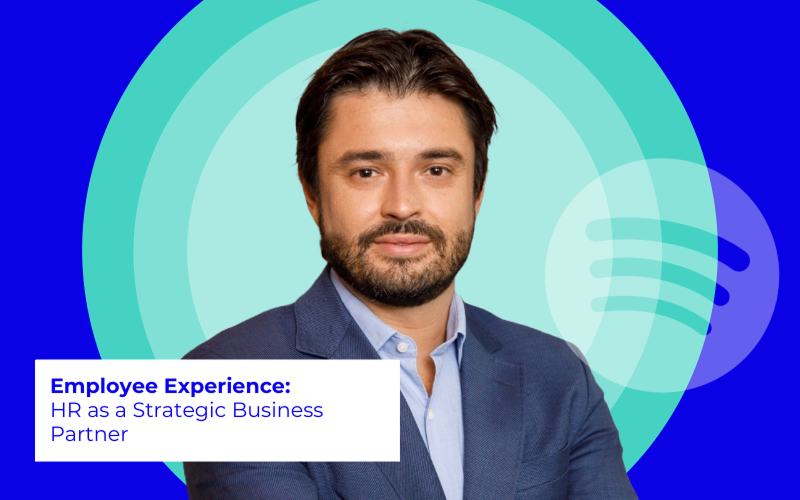
Far beyond organizational climate, the concept of employee experience addresses the complete journey of each professional who interacts with your company.
From the moment the employee signs the contract until the moment they leave the organization, all impressions, opinions, and feelings matter.
Moments such as recruitment, onboarding, the first trainings, the first recognition, achieving a promotion, and others are milestones in your employees’ journey.
Today we brought João Altman, Executive HR Director at VR Benefícios, to talk with us about how employee experience has become a topic of great importance at VR.
Hi João, thank you so much. Welcome—it’s an honor and a pleasure to have you here. Before anything else, let me
introduce you: João Altman, Executive Director of People and Culture at VR. João has a really great story, focused on
employee experience, and we’ve brought him here to share a bit of it.
João, before we start this conversation, tell us a bit about who you are for those who don’t know you or have never
seen you.
First, thank you, Débora, for the invitation. It’s a pleasure to be here with you at Clave. We’ve known each other for
quite some time and have worked together on a few projects.
I’ve been working in human resources for quite some time. I started my career in the financial market, worked at
Santander, Citibank (spent a good amount of time at Citibank), then moved to Disney to work in the ESPN division in
Brazil, always in human resources.
I took on this challenge at VR almost two years ago, leading the entire people and culture structure, and it has been
a pleasure to grow alongside the evolution of this career. The evolution of the people and culture profession is
becoming increasingly influential and important within organizations.
João, you told me a lot about employee experience, and I found that story very interesting. I’d like you to share with people what employee experience is like at VR.
Instead of talking about experience at VR, we often talk about the employee journey. A journey that starts from attraction—the first contact with the VR brand as an employer through social media and various environments where we seek candidates interested in working at VR—and then goes through several stages.
João, you told me a lot about employee experience, and I found that story very interesting. I’d like you to share with people what employee experience is like at VR.
A candidate’s experience with our recruitment team also goes through the hiring process and the onboarding integration
of that professional at VR, getting to know a bit about our culture. There are 45- and 90-day check-ins to track this
evolution, along with development processes, training, and recognition.
And we follow all the stages, all the way to the exit process, where we also gather information, seek understanding,
and continuously learn from every step.
When we talk about this journey, Débora, what’s interesting is that we also look at personas—not just the journey
itself, but also the types of people we have. It’s not possible to have a single journey for every VR employee.
So we try, using new methods and this new way of organizing a cycle of experience initiatives—both for the external
customer and the internal customer, our employees—to look at personas and, in a customized way, offer the best
possible experience for each individual. That’s how we approach this journey, aiming to ensure the best possible
experience for our employees.
Nice, João—and that’s really interesting because it’s a topic that’s very much on the rise. How do I provide a
journey, a learning path that is individualized? One where I acquire the knowledge that’s necessary for my
development. That’s quite different from the concept we used to see in the market, where everyone moves from point A
to B and then we all move forward together.
When you tell me, “let me understand what will be important for your development at this moment,” I assume you have a
series of indicators mapped to track this. Today, what do you look at? What are the main indicators you follow along
this journey, and how does this connect to the business? Because in the end, we say that all these people-related KPIs
directly impact the business. Tell us a bit about that.
Great that you brought this up, because to truly deliver a customized approach, you either need a lot of people or a
lot of technology—data and analytics—to be able to offer a precise and personalized experience.
Today, we’ve evolved significantly in this regard. It’s worth noting that VR is a company with over 40 years of
presence in the national market, but it’s also a company that keeps up with the times, constantly updating itself and
adopting best market practices. Increasingly, VR is a data-driven company, focused on automation and information
analysis so that we can offer the best experiences to both our clients and our employees.
The people area has a range of tools that support this, from a fully integrated employee database connected to our
systems—such as payroll, internal engagement survey tools, and performance management systems—all feeding into a
central data base. From there, we extract a variety of indicators that help us segment insights and develop highly
customized and assertive solutions.
Today, we closely monitor indicators such as employee engagement, internal NPS (which we call eNPS), as well as
traditional metrics like turnover, and headcount relative to revenue. These are part of our standard people analytics
dashboard. We also pay close attention to indicators of digital maturity and understanding of digital culture, since
this is a crucial factor in driving our business forward. We know that the more mature an organization is in terms of
knowledge and digital culture, the easier it becomes to stay close to the customer, understand their needs, and truly
place the customer at the center of the business—so that we can ultimately deliver more time and a better life, which
is the core purpose of VR Benefícios.
João, when you talk about this, it all seems so fluid, so easy—but we know there are HR teams and companies that still
struggle to make all of this tangible, especially connecting engagement indicators to financial results in the end.
How can this be done, or what is HR’s role in this process? Because often I conduct an analysis focused on people—to
understand whether they are engaged or not. That’s fine, but what does it impact? So this “what comes next,” from what
you’re sharing and from what I know about your experience, is extremely important.
So what is the role? How does HR articulate this to present it as data that truly matters?
I would actually start one step earlier, which is how you build these solutions—and that may be the key to success.
It’s
about building them together with your client, together with the business areas. Co-creating, collaborating, being
highly empathetic to the needs of the business, its day-to-day operations, and the people leading these initiatives,
so that you can be truly effective in your actions.
Having data and indicators is an important step—a necessary foundation for any action. But beyond that, you need to
bring people in to build together. We have to move away from that old HR role where we had almost total control over
development, delivered ready-made solutions, and practically forced our clients to use them. Many times they complied
because HR required it, which led to frustration on both sides—on the client side, where they often didn’t see added
value, and on the HR side, where we had to keep pushing people to adopt what had been created.
When you co-create, you gain commitment, participation, and engagement. From that point on, these initiatives become
company initiatives—business initiatives—where the client understands that they will support business growth.
I can give you several examples, from improving employee engagement to facilitate talent retention and reduce
turnover, which automatically generates important savings for the business. In addition, in terms of digital transformation,
these journeys help us develop solutions that increase engagement with the end customer, delivering more impactful and
precise results for the business—because the initiative started with preparing the professionals who operate at the front
line.
So, in a very clear way, it’s about building together, with HR acting as a facilitator of this process—not the sole
driver of people initiatives, but positioning people as a shared responsibility across the entire company.
And of course, we encounter barriers and challenges. We’re working to articulate and “sell” an idea, to understand
whether that need truly makes sense for our internal client. HR positions itself as a key facilitator, trying to
ensure that the people strategy is aligned with the business strategy.
Speaking of the main challenges—when you talk about starting by influencing, understanding, listening, and being
empathetic with your internal client to assess whether your HR strategy, programs, and initiatives would make sense
for them—we know it’s not always smooth sailing along the way.
Can you share some concrete examples of what really worked—a big win—because it was built collaboratively? Something
where the input from your internal client made a big difference? I’m sure you have some great stories you can share.
I think a really great example to share here, Débora, is the internal engagement survey we run weekly. It’s a
recurring survey, and we went through a conceptual shift in the company. People were used to those annual or biannual climate
and engagement surveys—long surveys with 60 or 80 questions that you would answer once a year or every two years. Then,
after some time, a series of analyses would come out, followed by action plans to address the most critical points.
Times have changed—the dynamics of business and the market have changed. We no longer have that kind of time, and the
need for immediacy, for quick results, requires real-time identification of critical issues.
So we decided to invest in a tool that captures the pulse of everyday work. It’s a weekly survey with five questions
that all employees answer. From that, we can measure engagement and NPS, as well as track progress across 10 factors
related to employee satisfaction. Based on this, managers can develop action plans in partnership with the people team
to address key issues.
At the beginning, the challenges were significant for several reasons. First, getting people to participate—many were
skeptical about the results. They were used to older surveys where they would respond but wouldn’t see meaningful
change. On the other hand, managers were concerned about exposure—about having their results visible to senior
leadership and potentially highlighting gaps in management or leadership quality.
So initially, we gradually increased participation and engagement, especially by involving managers in encouraging
their teams. When employees started to see that many initiatives were actually based on their own feedback—and when managers
realized that taking the survey seriously led to measurable improvements, higher engagement, lower turnover, and even
stronger talent attraction through employee referrals—the survey itself became something to celebrate within the
company. It evolved into one of our main people management tools.
In practice, it’s about starting small, aligned with agile principles—launching an MVP, testing, failing fast,
learning
quickly, and iterating continuously.
We’ve been constantly evolving this tool, and it has become extremely important. I can say that our progress over the
past year has been significant. After about a year and a half, we’ve reached our highest participation rate—nearly 80%
of employees respond weekly. We also have the highest NPS and engagement levels since we began measuring, along with
the lowest turnover rate recorded since we started tracking these metrics with this dashboard.
In the end, this isn’t just a result of the people area alone—it’s about the people team acting as a facilitator,
providing the right consulting and tools so that leaders take ownership and responsibility for building a company with
increasingly high engagement levels. Because ultimately, that translates into business results.
João, sometimes people might look at this and say, “oh, that’s easy—João is at VR, has the structure to analyze data,
got executive buy-in, and the project was a success.”
Today, what advice would you give—regardless of company size, or whether HR is more or less structured—on how to get
started? How do I prove my value as a people area, and how do I truly fulfill my role? The people function has taken
on a different role, evolving over time—from being seen as the area that simply mandated training and actions, to
becoming a true business partner.
What advice would you leave for people who need to start this entire process?
That’s a great question, because you have companies of different sizes and very different realities. I would really
start by understanding the role of the people area.
One of the main roles of the people area at VR is to disseminate the company’s culture. This goes beyond just the
people function—it also includes the entire digital transformation VR is going through, which today sits within the
people and culture structure, including agilists and agile masters—professionals responsible for accelerating
management practices using methodologies that support this cultural transformation and a more modern mindset.
You don’t necessarily need to have this full structure or all these tools you mentioned. The first step is to listen
to your employees and leadership to understand the company’s purpose—why the company exists. From there, you can
develop actions that engage employees. This doesn’t necessarily require large investments. The HR space has evolved
quickly, with many tools and solutions—especially HR techs—that don’t demand high investment. Many are accessible to
small companies, often on a per-user basis, allowing you to deliver an experience similar to that of large
organizations with relatively low cost. This can generate significant results for HR management.
So what I would say to these managers is: understand the company’s purpose. If it’s not clearly defined, encourage
leaders, executives, shareholders, or owners to reflect on it. At the same time, take the opportunity to talk, to
listen deeply to your people, and invite the entire company to collaborate and co-create together.
Move away from the idea that only HR understands or is responsible for people. HR should be a major facilitator, a
driver of culture, and an enabler of modern, connected management practices and tools—to transform the employee
experience, which is what we discussed at the beginning, into something increasingly rich and motivating, ultimately
driving business results.
Because in the end, we’re talking about something that translates into results—more motivated people, more connected
to the company’s purpose, will deliver better outcomes.
That’s measurable, right João. Several studies have already proven that.
João, well, I would love to stay here chatting with you all afternoon—there are so many stories to tell. I’ve followed
the evolution of the people and culture area at VR, and it’s a really great piece of work. But unfortunately, due to
time constraints, that’s not possible.
I’d like to thank you very much for your availability. The invitation is open for you to come back more often and
share the evolution of all these projects. We’ll be facing a post-pandemic scenario, how we dealt with all of this—so
consider yourself invited to return again.
Débora, I’m the one who should thank you for the invitation. And I’d also like to invite everyone who was interested
to follow us on social media—we have our LinkedIn, which is always updated with a range of initiatives, especially
from the people and culture area, but also related to our products and services for customers.
We have many things we’ve been doing, and we make a point of sharing them because we’re very proud at VR of what we do
for our employees. At VR, we have the premise that everything we do starts from the inside out. So we always look
inward first, because we believe that motivated employees naturally extend that positive energy to our customers,
making the experience genuinely meaningful.

Débora Honda
Has over 15 years of experience in performance improvement and learning projects across the main sectors of the economy. A specialist in Profile Mapping, with national and international projects focused on transforming organizational environments. A researcher on the impacts of digital transformation on the future of the labor market, she has already helped major companies build their Talent Management strategies.